





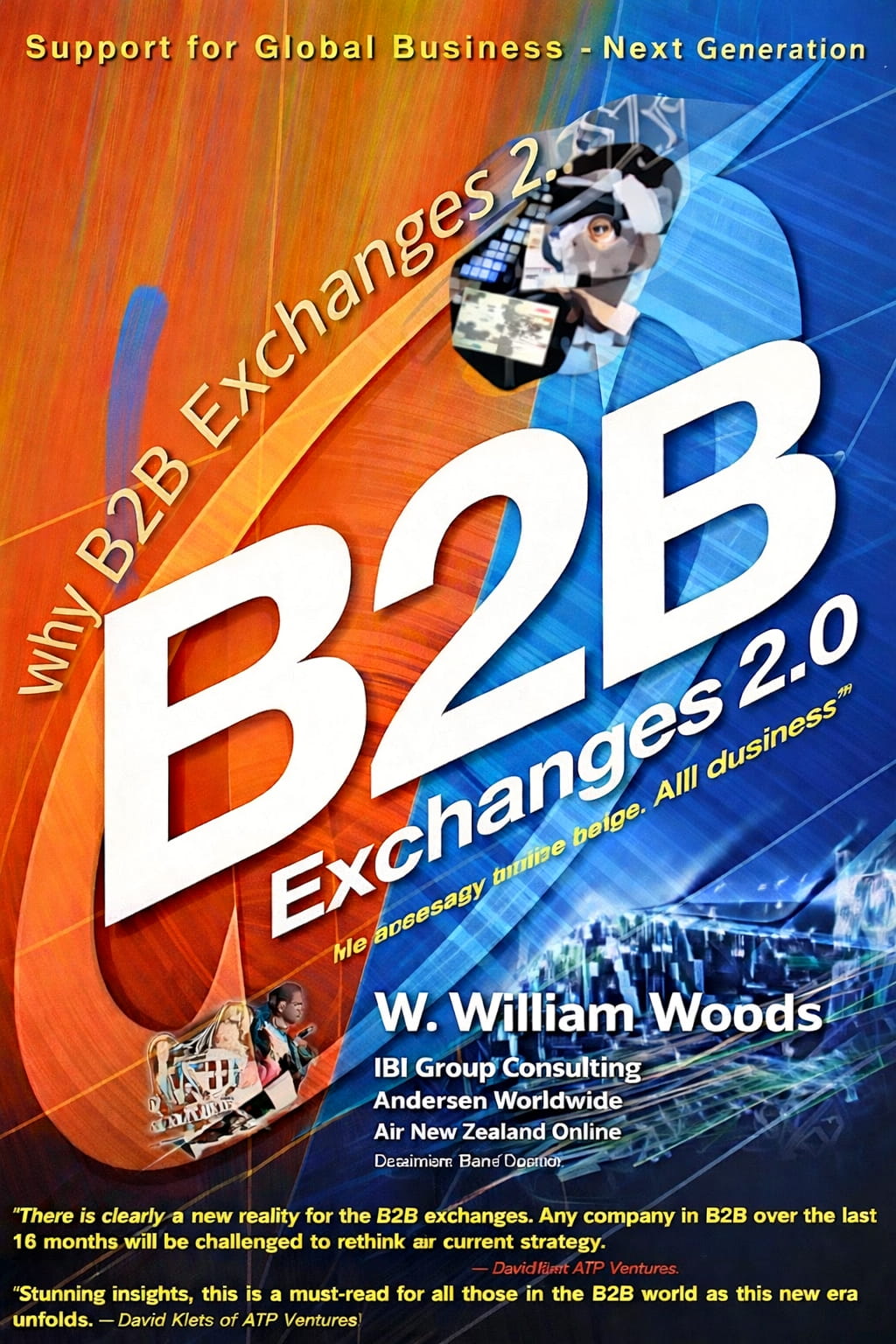
When William Woods’ and Arthur B. Sculley's bestseller, B2B Exchanges: The Killer Application in the Business-to-Business Internet Revolution, was published in 1999, the emergence of internet-based B2B exchanges was one of the hottest stories of the “dot-com” boom. Following the collapse of the technology bubble in early 2000, many publicly listed B2B companies failed dramatically—the so-called dot-bombs. Among the failures were many startup B2B exchanges. In B2B Exchanges 2.0, Woods showed that B2B exchanges remain major market forces. By analyzing the business models adopted by B2B exchanges, Woods skillfully extracted the important lessons to be learned from B2B exchange history. His analysis showed that many B2B exchanges were actually flourishing, and have fundamentally restructured their chosen markets.
Woods also covered the extraordinary story of EnronOnline, and stated that, despite the sudden demise of the online trading platform, derivatives trading would play a critical part in the future success of many B2B exchanges. Woods described the anatomy of third-generation (3G) B2B exchanges, and predicted that successful 3G exchanges would be the catalyst for the delivery of B2B web services. Christening these new exchanges “Babel fish” communication hubs, Woods explored how they would facilitate true program-to-program integration across corporate firewalls. Drawing on his decades of experience with offshore financial centers, Woods entered the highly sensitive "offshore" discussion, explaining not only why, but also how, B2B exchanges should locate and set up in offshore jurisdictions. In B2B Exchanges 2.0, Woods analyzed independent B2B exchanges, the industry consortia models, and the emerging private network exchanges.
Buy from Me
Buy from Amazon
About the Author

W. William Woods acts as a professional, independent, non-executive director.
A Canadian and British citizen, William has a wealth of international securities market experience and specific corporate governance expertise. He was a founder, and remains a member, of the Judging Panel for the Canadian Hedge Fund Awards. Licensed by the Cayman Islands Monetary Authority as a “Professional Director,” he serves on the boards of corporations, hedge funds, and the general partners of private equity, private credit, and private lending funds; as a member of advisory committees for limited partnerships; and as an Independent Review Committee chair/member for Canadian investment funds.
He is part of the directorship team at Hawksford Governance Services Cayman Ltd. and is a resident of Grand Cayman.
William has been the acting in-house legal counsel of the Hong Kong Stock Exchange and the CEO of the Bermuda Stock Exchange. He has advised governments and supranational aid agencies on the development of securities laws and financial services in several countries.
Educated in the United Kingdom, where he obtained an LL.B from the University of Manchester, William trained as a solicitor (admitted in England, Wales, and Hong Kong) and has been admitted as a barrister and an attorney in Bermuda. He obtained the Institute of Corporate Directors’ Diploma (ICD.D) in June 2017.
William is co-author, with Arthur Sculley, of B2B Exchanges: The Killer Application in the Business-to-Business Internet Revolution (ISI Publications, 1999). He is currently serving, or has previously served, as a director with several of the hedge funds mentioned in Famous Frauds and Financial Failures or in the website bonus materials, including Arrowhead, Bridgewater, Level Global, and Pharos. William has also acted as an expert witness in legal proceedings arising out of some of the hedge fund failures described here.